
The Studio investigates pedagogical frameworks for strengthening cognitive robustness, cognitive resilience, and independent agency while untraining predictability in GenAI-mediated ecosystems.
This humanistic work becomes increasingly important as society moves towards systemic dependence on GenAI ecosystems. Thus, we approach the cognitive robustness of future generations as a critical component of educational infrastructure, with implications for civic resilience, institutional trust, and national security.
- Inspired in part by Antonio Damasio’s work on emotions and decision-making, the Brazilian literature as a critical apparatus, and Calkins’ Primary Object Lessons for grounded experiences, we explore how emotions, discomfort, and creativity can support students’ resilience, awareness, and judgment in GenAI-mediated ecosystems.
- This page collects visual models, conceptual precursors, and research-assistant products that document the development of the Cognitive Robustness Research Studio.
- If you refer to concepts, visual models, or pedagogical frameworks from this site, please cite the relevant Studio artifact or the Studio page.
- How to cite: [Artifact title and author here.] The Cognitive Robustness Research Studio: Studio Artifacts. Grinnell College. URL.
The Two-Stage Story below introduces one of the studio's central provocations
How and where is your locus of control? Where does it move in hybrid human-AI ecosystems?
- Or, in other words, in what ways do hybrid agentic ecosystems (Human-AI systems) intersect with agency, cognitive robustness, and locus of control (Rotter 1954/1966)?
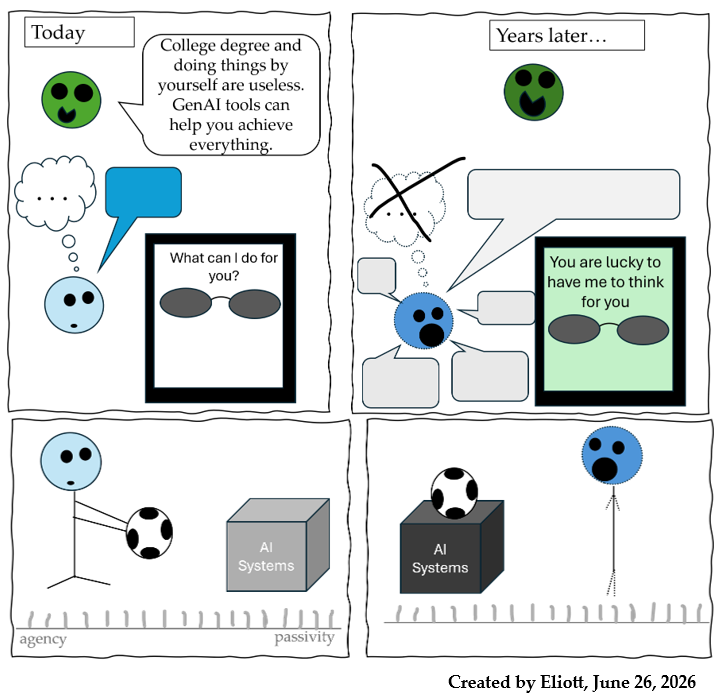
- How to cite this artifact: Eliott, F. (2026, July 8). “Two-Stage Story.” Cognitive Robustness Studio: Conceptual Precursors. https://doi.org/10.17605/OSF.IO/P7D3Q
Conceptual Precursors
- These conceptual frameworks helped shape the Cognitive Robustness Studio’s pedagogical foundations.
- The abstracts below were submitted in spring 2026 and later became conceptual precursors to the Studio’s research-based pedagogy.
1. [Abstract #01] From Machado de Assis to Cybersecurity: Not that kind of AI Literacy Course.
- Overview: Explores cognitive challenges arising in human-GenAI ecosystems, proposes the Brazilian literature as a critical apparatus, resulting in a research-based pedagogy that connects AI Hygiene, cybersecurity, and humanistic inquiry.
- Link to Full Abstract.
2. [Abstract #02] Cooperation vs. Coordination in Cognitive Robustness.
- Title. Can Terminological Inconsistency Benefit Power Asymmetry? Cooperation vs. Coordination and a Pedagogical Framework for Cognitive Robustness
- Overview: Examines how terminological inconsistency, power asymmetries, and misaligned mental models can create an illusion of user cooperation within hybrid human-AI infrastructures.
- Prior work. This artifact connects the Studio’s pedagogical framework to my earlier work on cooperation, coordination, MAS, and misaligned mental models.
- Link to Full Abstract.
Products - Research Assistants 2026
Description Writing: Imagination, Attention, and the Senses
- Inspired by the Brazilian writer José de Alencar, a Cognitive Robustness Studio activity invited research assistants to practice descriptive writing as a way to strengthen imagination, attention, and sensory engagement.
- In response, Edgar Romero wrote a vivid descriptive piece about the ELBICA Lab.
