Author: Edgar Romero, Cognitive Robustness Research Assistant, July 2026.
- How to cite this artifact: Edgar Romero, July. 2026. “A Fascinating Ecological System: the ELBICA Lab.” The Cognitive Robustness Research Studio: Studio Artifacts. Grinnell College. URL.
The ELBICA lab occupied its space like a living system rather than a room, less like an office, more like an organism built from intention, habit, and the accumulation of technical curiosity.
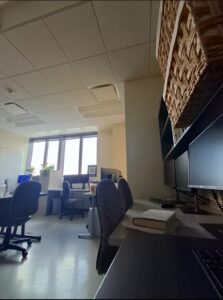 The whiteboard was never clean for too long. It carried the residue of ongoing thought with designs half erased and rewritten, uneven fragments of what once was, but among the functional clutter, on line stood out, “CS Wednesdays at 1:30pm in Noyce” It wasn’t just a reminder; it behaved like a ritual anchor, a recurring point in the lab’s calendar where discussion, designing, and direction all came together.
Against one wall sat the machines. An Alienware tower, likely an Aurora model, housed a 13th Gen Intel® Core™ i9 13900KF (24-Core, 68MB Cache, 3.0GHz to 5.8GHz P-Core Thermal Velocity). It wasn’t only a system, but it was one that announced itself, the faint internal flow, a presence that made even routine computation feel slightly cinematic. Around it, additional monitors formed an informal cluster of potential.
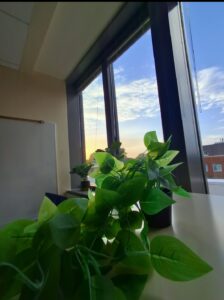 The desks carried the evidence of sustained attention: cables connected and unconnected, or the keyboards all scattered across. Notebooks with notes here or an idea there. There was a particular kind of order here, a working system managed very meticulously. By the window, plants leaned subtly toward the light. They were not decorative so much as collaborators, the quiet biological counterweights to the electronics. Their presence softened the presence of the hardware, as if the lab needed a reminder that not all systems are digital to remain alive.
The bookshelves told their own story. Visualization Analysis and Design sat near Computer Systems: A Programmer’s Perspective, both showing signs of repeated consultation, pages slightly worn at the corners. Nearby, more speculative or creatively inclined titles like Codex Seraphinianus suggested that the lab did not draw a strict boundary between engineering discipline and creative extensions. Theory, practice, and invention were not separated so much as stacked together and interwoven.
“There was an emotion that things were alive and together in the air.”
And then, the smaller details. The snack shelf that always seemed to replenish itself in quiet cycles, the mugs that migrated between desks, the faint sense that no one ever fully left the lab, only took a temporary breath of fresh air before returning.
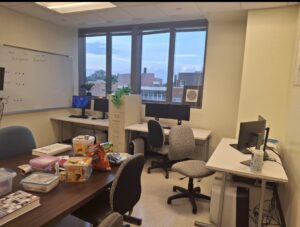 The ELBICA lab, in its arrangement, felt less like a place where projects were executed and more like a place where systems were continuously negotiated between hardware and intent, between design and constraint, between the people inside it and the ideas they were trying to make real.