Studio Artifacts

   The Studio investigates pedagogical frameworks for strengthening cognitive robustness, cognitive resilience, and independent agency while untraining predictability in GenAI-mediated ecosystems.

   This humanistic work becomes increasingly important as society moves towards systemic dependence on GenAI ecosystems. Thus, we approach the cognitive robustness of future generations as a critical component of educational infrastructure, with implications for civic resilience, institutional trust, and national security.

  1. Inspired in part by Antonio Damasio’s work on emotions and decision-making, the Brazilian literature as a critical apparatus, and Calkins’ Primary Object Lessons for grounded experiences, we explore how emotions, discomfort, and creativity can support students’ resilience, awareness, and judgment in GenAI-mediated ecosystems.
  2. This page collects visual models, conceptual precursors, and research-assistant products that document the development of the Cognitive Robustness Research Studio.
  3. If you refer to concepts, visual models, or pedagogical frameworks from this site, please cite the relevant Studio artifact or the Studio page.
    • How to cite: [Artifact title and author here.] The Cognitive Robustness Research Studio: Studio Artifacts. Grinnell College. URL.

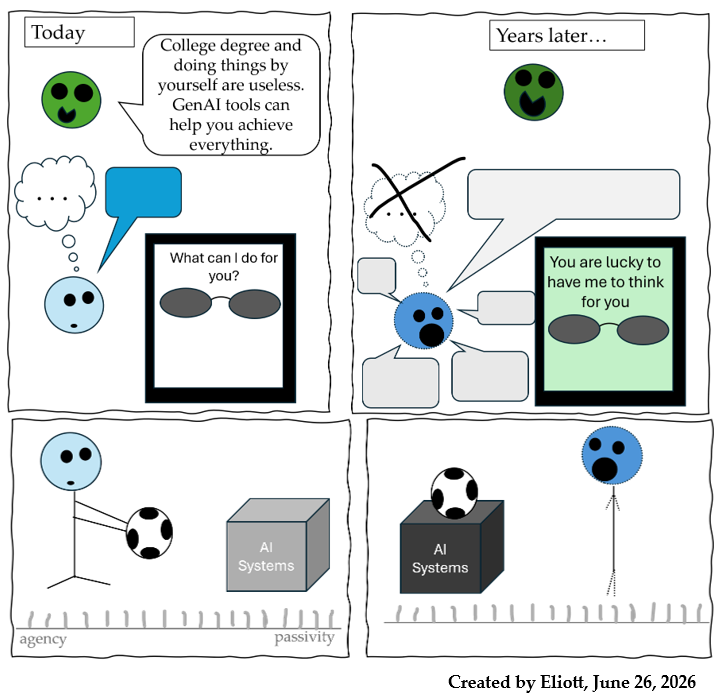
The Two-Stage Story below introduces one of the studio's central provocations

How and where is your locus of control? Where does it move in hybrid human-AI ecosystems?

  • Or, in other words, in what ways do hybrid agentic ecosystems (Human-AI systems) intersect with agency, cognitive robustness, and locus of control (Rotter 1954/1966)?Four-panel comic about GenAI dependence and loss of agency. A human promises that GenAI tools can do everything; years later, a human took that advice seriously and "passed the ball" of their agency to a GenAI tool that says, “You are lucky to have me think for you.”
  • How to cite this artifact: Eliott, F. (2026, July 8). “Two-Stage Story.” Cognitive Robustness Studio: Conceptual Precursors. https://doi.org/10.17605/OSF.IO/P7D3Q

Conceptual Precursors

  • These conceptual frameworks helped shape the Cognitive Robustness Studio’s pedagogical foundations.
  • The abstracts below were submitted in spring 2026 and later became conceptual precursors to the Studio’s research-based pedagogy.

1. [Abstract #01] From Machado de Assis to Cybersecurity: Not that kind of AI Literacy Course

  • Overview: Explores cognitive challenges arising in human-GenAI ecosystems, proposes the Brazilian literature as a critical apparatus, resulting in a research-based pedagogy that connects AI Hygiene, cybersecurity, and humanistic inquiry. 
  • Link to Full Abstract.

2. [Abstract #02] Cooperation vs. Coordination in Cognitive Robustness. 

  • Title. Can Terminological Inconsistency Benefit Power Asymmetry? Cooperation vs. Coordination and a Pedagogical Framework for Cognitive Robustness
  • Overview: Examines how terminological inconsistency, power asymmetries, and misaligned mental models can create an illusion of user cooperation within hybrid human-AI infrastructures.
  • Prior work. This artifact connects the Studio’s pedagogical framework to my earlier work on cooperation, coordination, MAS, and misaligned mental models.
  • Link to Full Abstract.

Products - Research Assistants 2026

Description Writing: Imagination, Attention, and the Senses

  • Inspired by the Brazilian writer José de Alencar, a Cognitive Robustness Studio activity invited research assistants to practice descriptive writing as a way to strengthen imagination, attention, and sensory engagement.
  • In response, Edgar Romero wrote a vivid descriptive piece about the ELBICA Lab.